
Published July 18, 2025
Rentaroof Leeds Rental Market Report – Q2 2025
In the second quarter of 2025, the rental market in Leeds showed clear signs of momentum, with rising supply, shifting demand patterns, and increased activity across emerging neighbourhoods. The market remains diverse, serving both its large student population and an expanding pool of young professionals. Average rents have remained relatively stable, with modest increases across multi-bedroom properties. Listings have grown significantly compared to the previous quarter, offering more choice for tenants and suggesting renewed confidence among landlords. Several neighbourhoods have begun to stand out as emerging hotspots due to regeneration, affordability, and strong rental yields. Meanwhile, established areas like Hyde Park are showing longer vacancy periods, highlighting evolving renter expectations.
1. Key Takeaways for Leeds rent
- Average Leeds rent: £750 for 1-bed, £995 for 2-bed, £1,150 for 3-bed homes.
- Listing volume: 7,434 listings in Q2, up 13% from 6,601 in Q1 2025.
- Fastest-moving areas: Holbeck (16 days), Kirkstall (18), Harehills (22).
- Slowest-moving areas: Hyde Park (84 days), Burley (55), Woodhouse (41).
- Student-heavy areas: Hyde Park, Woodhouse, Headingley offer the most suitable student housing.
- Professional demand zones: Lovell Park, Holbeck, and parts of Hyde Park lead in 1–2 bed flat listings.
- Emerging hotspots: Holbeck (regeneration), Horsforth (lifestyle appeal), Burley and Woodhouse (strong rental yields).
2. Average Rent Prices by Property Type (Q2 2025 – Leeds)
In Q2 2025, average rental prices in Leeds show a steady but modest rise compared to the previous year, particularly for multi-bedroom properties. Based on internal data from Rentaroof:
- 1-bedroom flats are renting for an average of £750 per month
- 2-bedroom flats average £995 per month
- 3-bedroom houses are priced at approximately £1,150 per month
Average Rent Prices by Property Type (Q2 2025 – Leeds)
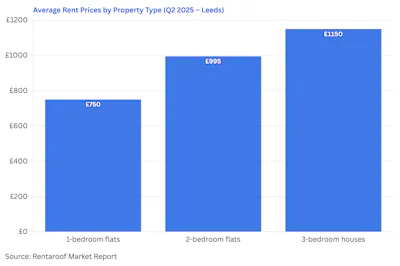
These figures reflect Leeds' continued appeal to both solo renters and growing households. While 1-bed flats remain a budget-friendly choice for young professionals and recent graduates, 2- and 3-bed homes are increasingly sought after by couples, families, and house shares, especially in well-connected suburbs and up-and-coming neighbourhoods.
3. Fast-Moving vs. Slow-Moving Areas (Q2 2025 – Leeds)
In Q2 2025, rental activity across Leeds shows clear contrasts between high-demand and slower-moving neighbourhoods. The variation in average days on market reveals where tenants are acting quickly and where properties tend to linger. Based on internal data from Rentaroof, the fastest-moving areas are:
- Holbeck, with an average time on market of 16 days
- Kirkstall, averaging 18 days
- Harehills, at 22 days
These neighbourhoods are gaining popularity due to their competitive pricing and growing appeal among young professionals and working tenants. Holbeck stands out as a regeneration zone with increasing interest from renters looking for proximity to the city centre at a lower cost. Kirkstall continues to perform well thanks to its transport links and retail options, while Harehills offers affordable alternatives for budget-conscious tenants. In contrast, some traditionally student-heavy areas are seeing significantly slower turnover:
- Hyde Park, with listings staying on the market for an average of 84 days
- Burley, at 55 days
- Woodhouse, at 41 days
Fast-Moving vs. Slow-Moving Areas (Q2 2025 – Leeds)
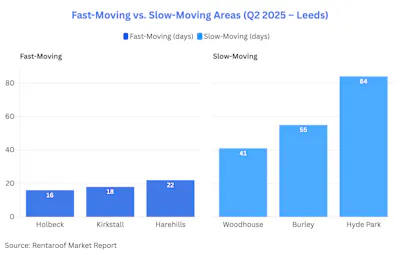
While these areas remain popular during peak academic periods, the extended time on market in Q2 may reflect the seasonal nature of student demand or a mismatch between supply and current renter expectations. Older housing stock and limited upgrades could also be contributing to longer vacancies, especially as students and graduates increasingly favour newer, better-equipped homes.
These trends suggest a gradual shift. While Hyde Park and Burley were once dominant rental zones, emerging areas like Holbeck and Kirkstall are becoming the new hotspots for faster-moving, year-round demand.
4. Student vs. Professional Demand (Q2 2025 – Leeds)
Leeds remains a key student city, home to multiple universities and a high turnover of young renters each year. At the same time, the city is also seeing growing demand from young professionals, particularly in areas close to the city centre or transport hubs.
Student Demand
The most student-friendly neighbourhoods are still those traditionally close to the University of Leeds and Leeds Beckett University. These areas offer the highest number of suitable properties for shared living and affordable rents:
- Hyde Park leads the list, with 1,218 total listings, of which 809 are suitable for students, typically shared houses with 3 to 6 bedrooms.
- Woodhouse follows, with 493 listings, including 281 student-suitable properties.
- Headingley is third, offering 505 listings and 276 student-appropriate homes.
These neighbourhoods continue to be favoured by student groups due to walkability to campus, availability of HMOs, and well-established student communities. However, some signs of oversupply (as seen in Hyde Park's longer vacancy period) suggest that while demand remains strong, quality and timing are becoming more decisive factors.
Professional Demand
Young professionals, especially recent graduates staying in Leeds, tend to look for 1- or 2- bedroom flats in areas that balance convenience, modern living, and affordability. The top three neighbourhoods in terms of listings for this demographic are:
- Lovell Park, with 570 listings for 1–2 bedroom flats
- Hyde Park, surprisingly still active with 483 listings suited for professionals, indicating a dual market role
- Holbeck, offering 423 listings, a sign of its ongoing transformation into a professional rental hotspot
Student vs. Professional Demand (Q2 2025 – Leeds)
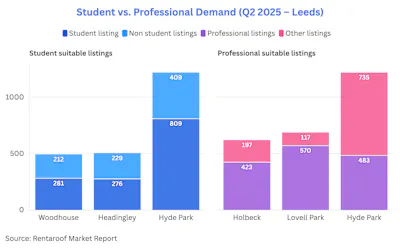
The presence of Hyde Park in both segments is notable. While traditionally student-focused, its growing number of smaller flats shows diversification in supply. Holbeck's rise among professionals also aligns with its fast-moving rental performance, indicating that demand is now driven less by area stereotypes and more by housing quality and urban connectivity. Overall, Leeds is witnessing a dynamic rental split, with clear but sometimes overlapping zones of interest.
5. Number of Available Listings (Q2 2025 – Leeds)
In contrast to trends seen in many other UK cities, Leeds experienced a notable increase in rental listings in the second quarter of 2025. Internal data shows:
- Q1 2025: 6,601 listings
- Q2 2025: 7,434 listings
Number of Available Listings (Q2 2025 – Leeds)
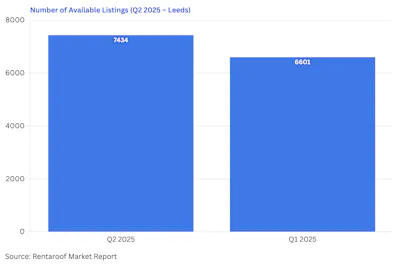
This represents a 13 percent quarter-on-quarter increase, indicating a growing supply of rental homes entering the market.
Several factors may contribute to this rise. Firstly, the post-winter period typically sees more landlords listing properties in anticipation of summer demand, especially from students and relocating professionals. Secondly, the increase could reflect a shift among private landlords choosing to re-enter the rental market amid stabilising mortgage rates and improved landlord confidence.
The growth in listings is not uniform across all property types. Much of the increase appears to come from one- and two-bedroom flats, which are in high demand among professionals and couples. Larger student houses also begin to appear in greater volume toward the end of Q2, aligning with the early stages of the academic rental cycle.
This surge in supply is expected to give renters in Leeds slightly more choice moving into Q3, though competition in high-demand neighbourhoods remains strong.
6. Emerging Hotspots by Area (Q2 2025 – Leeds)
Several neighbourhoods in Leeds are beginning to stand out as emerging rental hotspots, driven by a mix of regeneration projects, affordability, and growing tenant interest. In Q2 2025, areas like Horsforth, Holbeck, and parts of Burley and Woodhouse are showing clear signs of increased activity.
Horsforth, located to the northwest of the city centre, is gaining recognition as one of the UK’s most underrated areas to live. Its combination of strong schools, green spaces, and a village-like atmosphere has made it increasingly popular with young families and professionals. While property prices remain lower than in nearby suburbs, rental demand has risen sharply due to its strong transport links into the city and a growing reputation as a well-rounded residential area.
Holbeck, just south of the city centre, continues to benefit from ongoing regeneration efforts. Once known for its industrial character, the area is being transformed with modern apartments, creative workspaces, and improved public spaces. As a result, Holbeck is now attracting a younger, urban demographic, especially professionals seeking proximity to central Leeds at a more affordable price point. The average time a property stays on the market here is just 16 days, one of the fastest in the city.
Burley and Kirkstall, part of the LS4 postcode area, are also seeing growing interest. With their mix of traditional terraced housing and new developments, these areas appeal to both students and young professionals. Strong transport links, proximity to Headingley, and competitive rental prices make this part of the city a compelling option for renters. Notably, LS4 is currently achieving some of the highest rental yields in Leeds, a sign of investor confidence and sustained demand.
Finally, Woodhouse and the nearby city centre areas (LS2) are maintaining strong appeal, particularly among students and recent graduates. With walking distance to both major universities and central employment hubs, the area continues to deliver high occupancy rates and healthy rental returns.
These neighbourhoods reflect the shifting dynamics of the Leeds rental market. While traditional student areas remain active, the strongest growth is now occurring in locations that offer a mix of affordability, lifestyle appeal, and connectivity. For renters, this means more choice across different price points. For landlords and developers, it signals where investment may yield the most stable returns going forward.
Rentaroof Market report by:
Rohan Talwar | Online marketing- research
The information and data presented in this report were accurate at the time of publication, and every effort has been made to ensure their reliability. However, no reliance should be placed on the contents of this report as a sole basis for decision-making. Rentaroof.co.uk and its associated parties make no representations or warranties, express or implied, regarding the completeness, accuracy, or suitability of the information provided, and accept no liability for any decisions made or actions taken based on this content.