Skip to content
Picture of London with Big Ben and bridge

Published April 22, 2025

Rentaroof London Rental Market Report - Q1 2025

Explore the latest trends shaping the London rental market in Q1 2025. This report offers key insights into rental prices, affordability, supply and demand, and wider economic influences giving you a clear picture of where the market is heading. Whether you're a tenant searching for your next home or simply trying to understand the rental landscape better, this report is designed to inform your decisions. With no affiliations to estate agents, Rentaroof.co.uk provides a complete, independent view of the market, built on real-time data from across all London boroughs.

1. Key Takeaways for London rent

  • Average London rent: £2,300, up 4,5% compared to last quarter.
  • Most expensive boroughs: Knightsbridge, Belgravia, South Keningston.
  • Most affordable boroughs: Stepney, Hendon, Gants Hill.
  • Best price-to-quality borough: Greenwich offers the best balance of affordability and amenities.
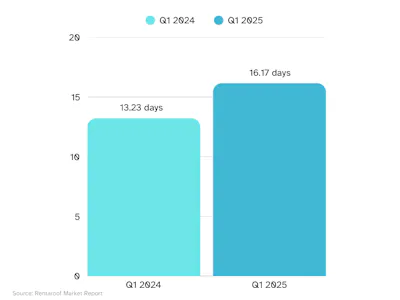
  • Average time to rent a property: 16,17 days, compared to 13,23 last year.
  • Economic outlook: Economic pressures, rising living costs, high interest rates, shifting work patterns, and upcoming regulations are reshaping rental demand, pricing, and availability across London in Q1 2025.

2. Average Rental Prices in London

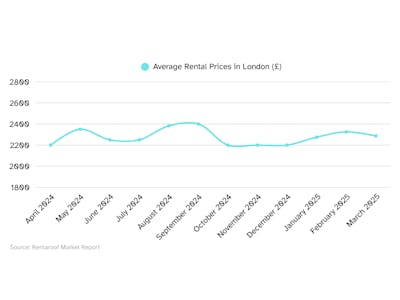
The London rental market continued to show signs of resilience and divergence in Q1 2025, with the average rent across the capital rising to £2,300. This marks a 4.5% increase compared to the previous quarter and a 2.3% rise year-on-year, indicating a modest but steady upward trend in rental costs overall.

Average rental price in London

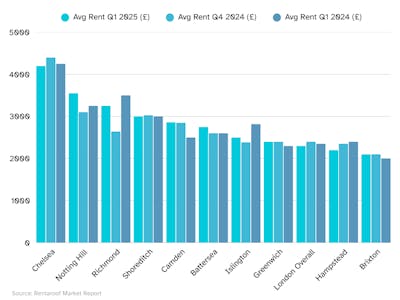
Average rental price per boroughs

Beneath the surface, however, the data reveals a complex picture. Some boroughs are seeing accelerated growth, while others appear to be cooling down.

Notting Hill stood out with a sharp quarter-on-quarter increase of 9.3%, bringing the average rent to £3,553. With a 14.5% rise over the past year, it reflects strong demand in this fashionable and centrally located area. Similarly, Camden experienced a significant quarterly surge of 14.4%, likely fuelled by its cultural appeal and strong connections to central London.

On the other hand, Richmond presents an interesting case: despite a 7.1% drop in rents compared to the previous quarter, it recorded the highest year-on-year growth at 23%. This suggests that while prices may have stabilised recently, long-term demand for suburban, green neighbourhoods remains robust.

At the higher end of the market, Chelsea maintained one of the city’s highest average rents at £4,117, although it saw a slight quarterly decrease of 1.1% and a 4.5% decline compared to the same period last year potentially reflecting some price correction in the luxury segment.

Meanwhile, areas like Hampstead and Islington saw more pronounced quarterly declines (–8.3% and –11.3% respectively), which may point to seasonal adjustments or short-term dips in demand.

Overall, the data reflects a fragmented market, where tenant preferences, supply constraints, and localised demand dynamics are shaping rental trends at the borough level. While core and trendy neighbourhoods continue to command premium prices, fluctuations suggest renters are actively re-evaluating location, value, and lifestyle, driving both opportunity and uncertainty across the London rental landscape.

London's most expensive areas:

In the first quarter of 2025, Knightsbridge has claimed the top spot as London’s most expensive rental area, with average monthly rents reaching a staggering £10,400. Nestled between Hyde Park and South Kensington, this prestigious neighbourhood has long been synonymous with exclusivity, wealth, and international allure.

What sets Knightsbridge apart is not just its location, but the lifestyle it offers. Home to landmarks like Harrods, the Victoria and Albert Museum, and some of the capital’s finest hotels and restaurants, the area attracts a global elite high-net-worth individuals, diplomats, and celebrities who are willing to pay a premium for privacy, convenience, and luxury.

The housing stock in Knightsbridge is both scarce and exceptional. Historic white-stuccoed townhouses sit alongside ultra-modern developments with concierge services, private gyms, and underground parking. Properties here are often finished to the highest standard, with features such as marble floors, custom interiors, and panoramic views over Hyde Park.

Adding to the high rental prices is a chronic lack of supply. Strict conservation regulations and heritage protections limit new developments, keeping available stock limited and demand high. In this market, exclusivity is both a feature and a driving force behind the soaring costs.

In short, Knightsbridge is not just a place to live, it's a statement. For those who can afford it, the area offers an unmatched blend of centrality, luxury, and prestige, solidifying its place at the top of London’s rental market.


Top 3 most affordable boroughs: 

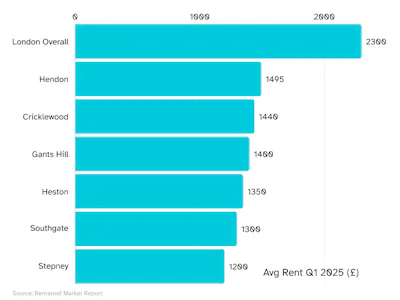
While rental prices in many parts of London continue to rise, there are still several boroughs that stand out for their relative affordability. In Q1 2025, the three most affordable areas in the capital were Stepney, Southgate, and Heston, all offering average monthly rents well below the London-wide average of £2,300.

Stepney tops the list as the most affordable borough, with an average monthly rent of £1,200. Located in East London, Stepney offers good connectivity via the District and Hammersmith & City lines, and is attracting price-sensitive renters who are looking for central access without the central London price tag. Its blend of cultural diversity, regeneration projects, and proximity to Canary Wharf makes it a compelling option for young professionals and families alike.

Next is Southgate, situated in North London, where the average rent stands at £1,300. Known for its suburban charm, green spaces, and strong local community, Southgate appeals especially to renters seeking a quieter lifestyle while maintaining access to central London via the Piccadilly Line. The area offers good value for money, particularly for those in search of larger properties at lower costs.

Heston, located in the borough of Hounslow in West London, comes in third with an average rent of £1,350. It offers excellent access to Heathrow Airport and key transport links via the M4, making it ideal for airport staff, frequent flyers, and commuters alike. With a mix of family housing and more affordable flats, Heston combines convenience and affordability in one of London’s more budget-conscious submarkets.

These areas demonstrate that despite the high average rent in the capital, affordable options still exist particularly in boroughs that balance accessibility, amenities, and value for money. As rental competition increases in more expensive zones, these neighbourhoods are likely to see growing interest from price-sensitive renters in the months ahead.

Best price-to-quality ratio:

While rental costs in London can vary widely, some areas offer a standout price-to-quality ratio delivering strong value through a combination of affordable pricing, solid infrastructure, and desirable living conditions. These boroughs may not have the lowest absolute rents, but they provide renters with the most compelling balance between what they pay and what they get in return.

One such area is Greenwich. With an average rent of £2,433, Greenwich sits just above the city average, yet offers exceptional value. Residents benefit from a scenic riverside setting, rich historical heritage, spacious parks, and quick access to Central London via the DLR and the Elizabeth Line. The neighbourhood blends charm and connectivity in a way few others do at this price point.

Another strong contender is Camden, where the average rent of £2,860 comes with excellent cultural amenities, strong transport links, and a vibrant social scene. Despite its central location, Camden remains relatively affordable compared to nearby zones with similar appeal.

Finally, Battersea also ranks high in price-to-quality ratio. For £2,750 per month, renters gain access to newly developed housing, riverside living, and major transport upgrades, including the Northern Line extension. The area's transformation has made it one of the most attractive choices for young professionals and families alike.

These boroughs prove that the best rental experiences in London don’t always come with the highest price tag. Instead, they offer a smart blend of affordability, livability, and long-term value making them ideal choices for renters seeking more than just a place to live.

3. Average Rent by Property Type – Flats, Houses, and Rooms Compared

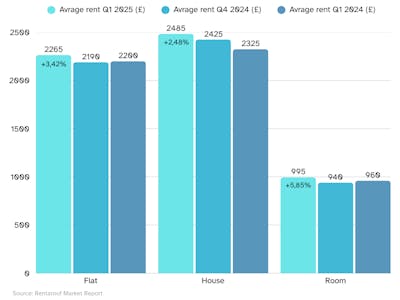
In Q1 2025, rental prices across London varied significantly depending on property type, highlighting shifting demand and affordability dynamics within the market.

Flats, the most common rental choice in the capital, recorded an average monthly rent of £2,265. Prices rose 3.42% quarter-on-quarter and 2.95% year-on-year, indicating steady growth amid continued interest from professionals and couples seeking convenience and centrality.

Houses remained the most expensive category, with an average rent of £2,485 per month. While quarterly growth was more modest at +2.48%, the year-on-year increase of 6.88% suggests that larger homes often located in suburban or family-friendly areas are experiencing renewed demand, potentially driven by hybrid working patterns and a desire for more space.

Rooms, often the most accessible entry point to the London rental market, saw the sharpest quarterly increase at +5.85%, bringing the average monthly rent to £995. Despite being the lowest in absolute value, the sustained year-on-year rise of 3.65% highlights affordability pressures in the shared living segment where competition for well-located rooms remains intense.

These figures reflect how different property types are evolving in response to market pressures and tenant preferences, offering valuable insight for landlords, investors, and policy makers.

4. Rental Property Turnover

Average time on market

Average Time on Market – Slower Letting Pace Signals Shift in Renter Behaviour

In Q1 2025, rental properties in London remained on the market for an average of 16.17 days before being let to a notable increase compared to 13.23 days in the same period last year. This represents a 22.2% rise in average time on market year-on-year.

The longer listing duration may reflect a cooling in urgency among renters, possibly due to increased supply in certain boroughs or more selective decision-making in the face of high rental costs. It could also indicate that while demand remains solid, renters are taking more time to compare options, negotiate prices, or wait for better value in a market where affordability is under pressure.

Although the difference of just a few days may seem marginal, the upward shift signals a change in market dynamics where speed is no longer the overriding factor, and value-for-money and flexibility are playing a larger role in tenant behaviour.

Fastest-Moving Areas – Haringey Leads with Quickest Rental Turnaround

In Q1 2025, Haringey stood out as the fastest-moving rental area in London, with properties being let in just 5.05 days on average. This is significantly faster than the citywide average of 16.17 days, highlighting an exceptionally strong demand in the borough.

Located in North London, Haringey benefits from a strategic mix of affordability, connectivity, and urban vibrancy. Popular areas such as Wood Green, Tottenham, and Crouch End offer quick access to central London via the Piccadilly and Victoria lines, while still maintaining relatively lower average rents compared to neighbouring zones.

The borough’s diverse housing stock, which ranges from period homes to modern flats, appeals to a wide spectrum of renters from young professionals and students to growing families. Recent regeneration efforts in parts of Tottenham have also played a role in boosting the area’s desirability, attracting tenants looking for good value in an up-and-coming location.

Haringey’s rapid rental pace suggests not only strong local demand but also a highly competitive market where listings are quickly picked up often within days of becoming available. This dynamic positions Haringey as a key borough to watch in the evolving landscape of London’s rental sector.

Slowest-Moving Areas – Norbury Faces Slower Rental Turnaround

At the other end of the spectrum, Norbury recorded the longest average time on market in Q1 2025, with properties taking 28.83 days to be rented, nearly double the London-wide average of 16.17 days. This slower pace suggests that demand in the area is less immediate or that renters are more hesitant to commit quickly.

Located in South London, Norbury is a largely residential area with fewer direct transport links to central London compared to neighbouring boroughs. While it offers more spacious and affordable housing, its relative distance from key business hubs, combined with limited lifestyle amenities, may contribute to longer decision times among potential tenants.

Another contributing factor could be oversupply within certain property types or a mismatch between what's offered and current renter preferences especially if the housing stock is older or less modernised. In a market where location, accessibility, and flexibility are increasingly valued, peripheral zones like Norbury may be experiencing a lag as renters prioritise connectivity and lifestyle over space.

While Norbury’s slower rental turnaround doesn't necessarily indicate a weak market, it does highlight the growing importance of matching product to renter expectations particularly in areas that lack the draw of inner-city convenience or high-demand amenities.

The London rental market continues to evolve in response to broader economic pressures. From inflation and interest rates to employment patterns and regulatory reform, several key trends are shaping both tenant behaviour and landlord strategies in early 2025.

Inflation and Cost of Living

Although inflation has cooled slightly compared to its 2022–2023 peaks, the cost of living in London remains high, particularly for essentials like food, energy, and transport. This has had a dual impact on the rental market: while landlords have increased rents to keep pace with higher maintenance and financing costs, tenants are more price-sensitive and selective in their housing choices. As a result, demand is shifting toward shared housing, smaller units, and outer boroughs where affordability is still within reach.

Interest Rates and Mortgage Affordability

The Bank of England has maintained relatively high interest rates to curb inflation, which continues to affect buy-to-let landlords and property investors. Higher borrowing costs mean reduced profitability for many landlords, especially those with variable-rate mortgages. In some cases, this has led to fewer new rental properties entering the market, tightening supply and placing upward pressure on rents particularly in high-demand areas. Some landlords are also passing on increased financing costs directly to tenants.

Employment Trends

London’s labour market remains resilient, with growth in key sectors like technology, finance, and healthcare. However, the shift toward hybrid and remote working continues to influence where people choose to live. Tenants are more willing to consider locations slightly further from central business districts, provided they offer good connectivity and quality of life. This has helped sustain demand in boroughs like Greenwich, Southgate, and Battersea, where renters find better value for money and more living space.

Regulatory Changes

Recent and upcoming rental regulations are also shaping the market. Landlords are preparing for the impact of the long-anticipated Renters Reform Bill, which includes proposals such as:

  • Abolishing Section 21 (no-fault evictions)
  • Introducing a single system of periodic tenancies
  • New minimum housing standards for rental properties

While the full implementation timeline is still being clarified, these changes are expected to enhance tenant protections, but may also lead to increased compliance costs for landlords and a possible reduction in rental stock if some decide to exit the market altogether.

7. Understanding the London Rental Market

Navigating the rental landscape in London can be complex, with availability and pricing varying widely across boroughs. Access to accurate and up-to-date information can support more informed decision-making.

Key aspects of the current rental environment include:

  • Comprehensive listings: A broad view of rental properties across all London boroughs helps provide clarity on what’s available and where.
  • Refined search criteria: Using filters such as price range, location, and number of bedrooms can make it easier to identify relevant options.
  • Market insights: Keeping track of trends, data, and developments in the rental sector supports a better understanding of pricing dynamics and emerging hotspots.

Stay tuned for our next Rental Market Report in July 2025 for more insights into pricing trends, fast-moving areas, and what’s shaping the future of renting in London.

Rentaroof Market report by:

Rohan Talwar | Online marketing- research

Mark Bruggeling | Senior Data Analist

The information and data presented in this report were accurate at the time of publication, and every effort has been made to ensure their reliability. However, no reliance should be placed on the contents of this report as a sole basis for decision-making. Rentaroof.co.uk and its associated parties make no representations or warranties, express or implied, regarding the completeness, accuracy, or suitability of the information provided, and accept no liability for any decisions made or actions taken based on this content.